
For FFL-regulated firearms and ammunition manufacturers in DFW and San Antonio, the standard answer to "can we deploy AI on the factory floor?" has been no. Any analytics or inference workload routed through a public hyperscaler creates a data-residency problem and a potential export-control exposure the moment ITAR or EAR-controlled production data enters the pipeline. That constraint has kept AI off most FFL plant floors.
Microsoft's announcement of a collaboration with Armada to deliver Azure Local on Armada's Galleon modular datacenters is the first formally published sovereign edge architecture from a major enterprise platform vendor that directly addresses this problem. The question is whether it actually solves it for your operation, or whether it is a promising architecture that still requires significant compliance verification before it can touch ITAR-controlled data. Related: AI Readiness for Process Manufacturers: What Your Data Architecture Must Support Before an Azure ML or Dynamics 365 Pilot Related: AI Digital Twin Readiness: What the Unilever-Accenture Deployment Means for Mid-Market Manufacturers' MES and Shop-Floor Data
What Microsoft and Armada Are Claiming
According to Microsoft's official Azure blog, the collaboration brings Microsoft Sovereign Private Cloud capabilities to Armada's Galleon modular datacenters (MDCs). The stated design intent is to run secure, compliant workloads in "intermittently connected, contested, and even fully disconnected environments." Related: NVIDIA's Industrial AI Cloud Signals a Compute Stack Shift That US Manufacturers Should Audit Now
The key architectural claims from the announcement:
- Azure Local is described as Microsoft's "on-premises cloud platform that can be used in disconnected and sovereign scenarios," meaning AI inference runs without an active connection to Azure public cloud.
- A validated sovereign reference architecture shows how Sovereign Private Cloud "operates on and interoperates with the Armada Edge Platform, enabling customers to deploy Azure services closer to where data is created, while retaining full control over their data, operations, and governance."
- Foundry Local, part of Microsoft Sovereign Private Cloud, is positioned to let customers "deploy, govern, and operate AI entirely within their own trusted boundary, supporting national sovereignty, classified workloads, and highly regulated data pipelines."
- Foundry Local specifically allows customers to "run AI inference and analytics locally, even when disconnected from the public cloud."
The infrastructure layer supports multi-rack scalability, hyperconverged and SAN-backed storage, and resilient multi-network connectivity across satellite, LTE/5G, RF, and SD-WAN. That last point is relevant for manufacturers with remote testing ranges or multi-site production environments across the Texas Triangle.
Microsoft's announcement describes the solution as supporting "security, compliance, and hardening aligned to sovereign, government, and regulated workloads." Defense, public safety, energy, and critical infrastructure are the named target sectors.
Why FFL Manufacturers Cannot Accept This at Face Value
The architecture is real. The compliance gap is also real.
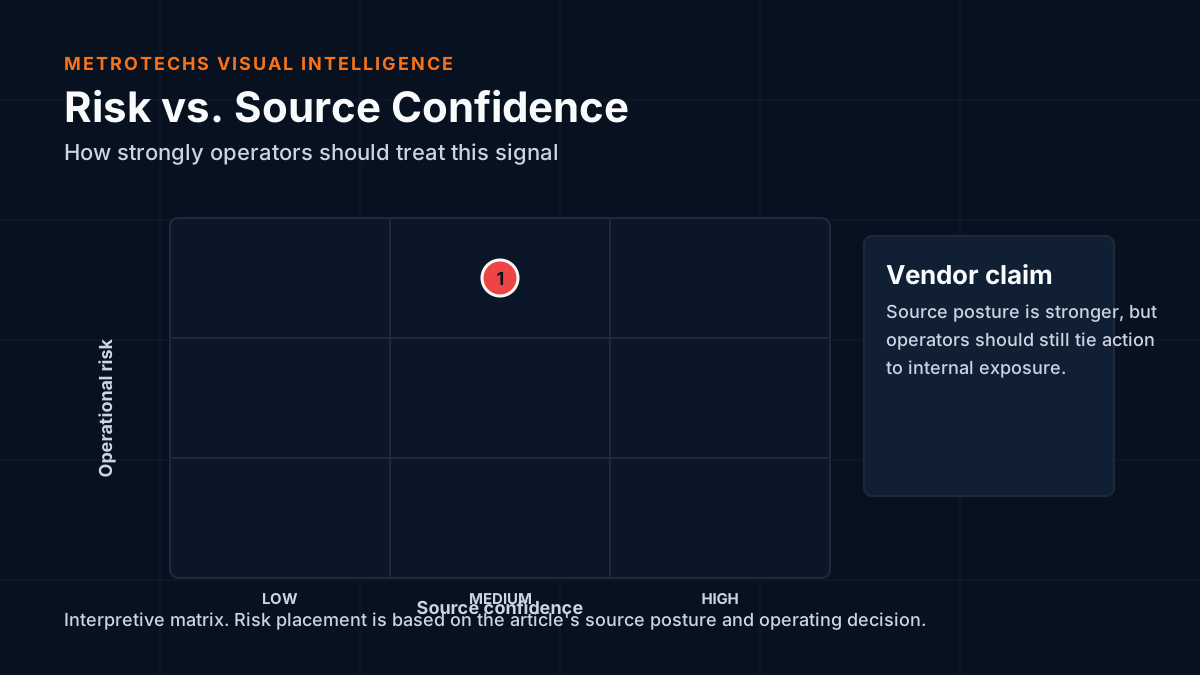
Microsoft's blog uses words like "sovereign," "compliant," and "regulated workloads," but the announcement does not name a single specific certification. No FedRAMP High, no CMMC level, no ITAR-compliant program authority, no EAR commodity jurisdiction determination, no ATF data-handling attestation is cited.
This is not a minor footnote. For a Type 07 FFL or SOT manufacturer in the DFW or San Antonio corridor:
- ITAR (International Traffic in Arms Regulations) controls the physical, digital, and systemic handling of technical data related to defense articles. If AI inference on your MES data touches a controlled technical data set, the infrastructure processing it must operate within a compliant boundary.
- EAR (Export Administration Regulations) adds similar controls for dual-use items and technologies. Ammunition and firearms components regularly appear on the Commerce Control List.
- ATF Acquisition and Disposition records — the bound book requirement — must remain accurate, auditable, and accessible to ATF inspectors at any time. Any system touching serialization, inventory, or transfer records carries that compliance obligation.
The announcement does not confirm whether Microsoft holds or is pursuing specific ITAR compliance authorization, an EAR technology control plan, or any ATF-specific data-handling attestation for the Azure Local and Galleon stack. That information must be obtained directly from Microsoft before any controlled data goes near this infrastructure.
Where the Exposure Shows Up in FFL Production Environments
The highest-risk integration points for FFL manufacturers evaluating this architecture are not the AI models themselves. They are the data pipelines connecting AI inference to regulated systems.
MES to AI inference layer. If your MES tracks production runs against controlled technical data — chamber specifications, ballistic performance data, component tolerances on USML-listed items — that data set may be ITAR-controlled. Running AI quality control or production analytics on it requires the inference environment to sit inside your compliant boundary. Azure Local claims to provide that. Confirmation requires documentation.
ERP supply chain data. Demand planning and supply chain visibility workloads often touch supplier data, bill of materials structures, and procurement records that reference controlled components. Routing that data through any inference layer outside your trusted boundary creates exposure.
A&D records and serialization. ATF bound book records and Form 4473 data cannot move through systems with ambiguous data residency. If an AI agent is designed to flag serialization anomalies or assist with compliance reporting, it must operate entirely within ATF-auditable infrastructure.
Identity and access controls at the physical boundary. The Galleon MDC is a modular physical unit. FFL facilities have specific access control requirements. Who can physically access systems that touch A&D records matters to ATF inspectors. Whether a Galleon deployment satisfies those physical security requirements is not addressed in the announcement.
What to Audit Now
Before any ITAR/EAR-controlled production or supply chain data touches Azure Local on a Galleon MDC, the following items require documented verification.
Control-plane telemetry behavior. Azure Local's control plane manages updates, licensing validation, and operational telemetry. Verify whether any of these mechanisms transmit data to Microsoft's Azure public cloud during normal operation, during update cycles, or during licensing checks. "Disconnected" in a marketing context is not the same as zero outbound telemetry. Get the technical documentation.
Compliance certifications in writing. Obtain from Microsoft the specific compliance attestations for the Azure Local and Sovereign Private Cloud stack: ITAR compliance authorization or exclusion determination, EAR technology control plan applicability, CMMC level if pursuing DoD customer relationships, and any FedRAMP High or equivalent authorization. "Aligned to sovereign and regulated workloads" is a marketing phrase. The actual certifying documents are what your export control officer and legal counsel need.
Armada Galleon physical security specifications. Confirm whether the Galleon MDC hardware meets FFL facility access control requirements: physical access logs, tamper detection, environmental controls, and audit trail documentation that would satisfy an ATF inspection. These specifications are not published in the announcement and must be requested directly from Armada.
ERP, accounting, and data ownership audit. Before deploying AI inference on any production data, verify which system holds authoritative records for inventory (serialized and non-serialized), orders, fulfillment, and A&D-relevant transactions. If ownership is split across ERP, accounting software, and separate compliance tools without clear data governance, an AI layer adds conflicting records rather than visibility.
MES integration data classification. Walk through every data field your MES captures and classify it against USML (United States Munitions List) and CCL (Commerce Control List) categories. The inference layer only needs to be inside the compliant boundary for data that is actually controlled. This classification work must happen before architecture selection, not after.
What to Watch Next
The announcement includes no pricing structure, no hardware availability timeline, and no named customer deployments. Armada is a private company, and no independent technical documentation for the Galleon MDC architecture has been published. Both gaps matter for procurement decisions.
Watch for:
- Microsoft publishing specific compliance authorization documentation for Azure Local in regulated manufacturing contexts, particularly ITAR program authorization and CMMC Level 2/3 boundary documentation
- Armada releasing technical specifications and U.S. commercial availability timelines for Galleon MDC deployments
- DoD or defense-industrial base pilot customer references that validate the architecture under actual ITAR operating conditions
Bottom Line
This is the first commercially described on-premise sovereign AI architecture from a Tier 1 enterprise platform vendor that is architecturally capable of addressing the data-residency problem FFL manufacturers in the Texas Triangle face. It has a validated reference architecture and names the right sectors.
What it does not provide is a compliance answer. The announcement comes exclusively from Microsoft's own blog. No independent technical review, no certifying body confirmation, and no ITAR/EAR authorization documentation appears in the published materials.
Open the evaluation now. Request compliance documentation from Microsoft, request physical security specifications from Armada, and run the MES data classification work internally. Do not commit ITAR or EAR-controlled production data to any AI platform — including this one — until that documentation is in hand and reviewed by your export control counsel.